A VIN check allows buyers to verify a vehicle’s history, including accidents, title branding, theft records, and mileage accuracy. An online VIN decoder can identify vehicle specifications using the 17-digit VIN. Free tools (EpicVIN, NICB, NHTSA) help with early screening. Paid vehicle history reports (EpicVIN, Carfax, AutoCheck) provide deeper data before purchasing a used car.
Key Moments When a VIN Check is Absolutely Necessary
The 17-digit vehicle identification number links the physical car to its paperwork. A single search can reveal serious issues long before a test drive. Skipping VIN checks means trusting a stranger’s story about the car’s background. That is not wise when you are making a purchase that affects safety and money.
- When buying a used car from a private seller or a small lot.
- Before making a purchase at an online auction or marketplace.
- When the price is far below that of similar cars with the same model year.
- If the seller cannot explain gaps in maintenance records or ownership history.
- Any time a vehicle has a salvage, rebuilt, or flood brand on the title.
- Before registering the vehicle with your local DMV or insurer.
Nearly 30% of reports show serious vehicle issues.
Where to Locate Your VIN on a Vehicle
To use any check service, you must first find the VIN characters on the vehicle itself. This code is made of 17 characters of letters and numbers and serves as a permanent number for the car. That number appears in every major record for that specific automobile. It appears in several places, and all copies should match. If they do not, the automobile’s history may be far more complicated than advertised.
- At the base of the windshield on the driver’s side of the dashboard.
- On the driver’s door jamb sticker that lists tire and vehicle specifications.
- Stamped into the frame or body rails on many trucks and SUVs.
- On a plate in the engine bay or near the assembly plant label.
- Printed on registration, insurance documents, and loan contracts.
- Sometimes, on a sticker in the glove box or trunk spare tire well.
VIN Report Data Sources Explained Simply
VIN checks do not work by magic. Behind every report is a web of connected databases. Together, they build vehicle history information that follows the car’s background over time. A good report pulls from state agencies, manufacturers, insurance companies, and repair shops. The stronger the database coverage, the more complete the picture of the VIN will be.
| Data Source | What It Provides | Who Maintains It |
| State DMV records | Title data, branding, mileage, and model year | Individual states in the U.S |
| Manufacturers & NHTSA | Safety recalls and technical bulletins | Automakers, World Manufacturer Identifier (WMI) data, Department of Transportation |
| Insurance companies & NICB | Theft, total loss, and some accident records | Each insurer and the national anti-fraud groups |
| Police, auctions, and salvage yards | Stolen, recovered, or salvage vehicle details | Law agencies and auction operators |
| Service centers and dealers | Maintenance records and basic information on maintenance | Repair facilities and dealer networks |
How to Choose the Right VIN Check for Your Situation
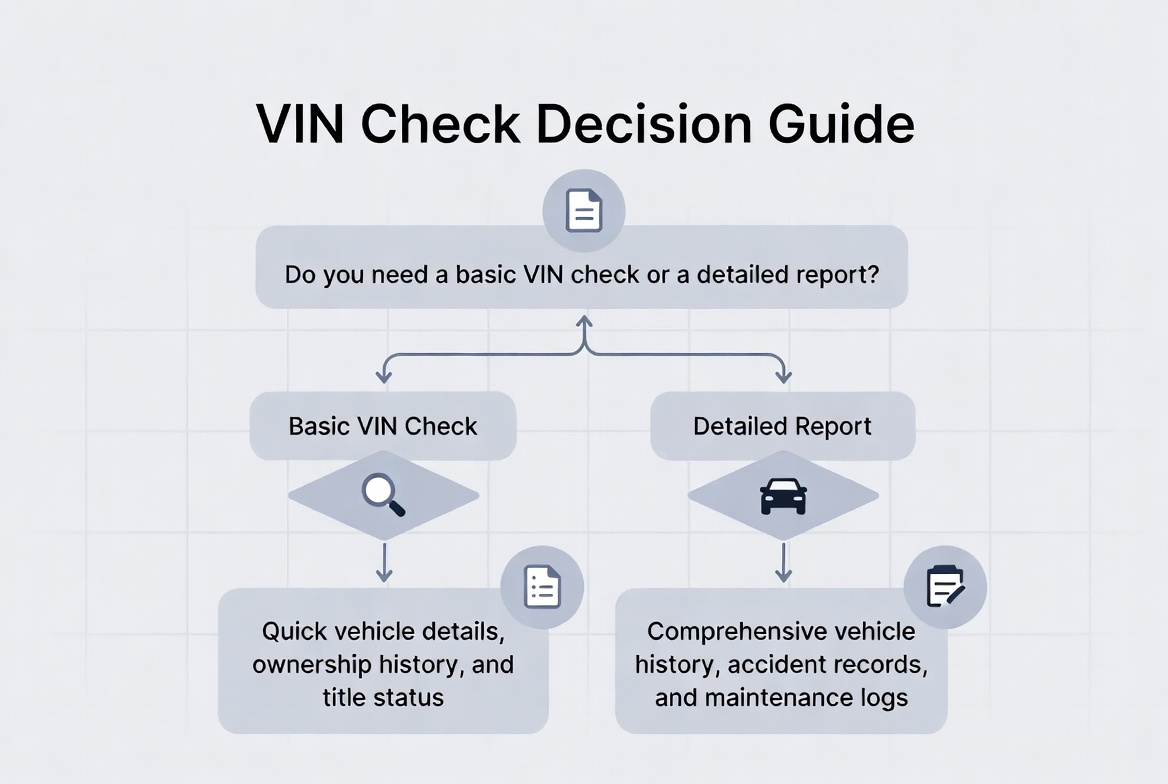
There are many VIN check options, and not every situation needs the same report depth. Start by asking how much you can afford to lose on this transaction. A cheap used automobile from a stranger deserves more scrutiny than a certified car from a large dealer. A quick free VIN check works as a filter, but deeper research may still be needed. Think about whether you are only browsing or close to purchasing.
- Use a no-cost check for early screening and obvious salvage or theft issues.
- Choose a low-cost VIN check service when you are casually shopping for a used car.
- Order a full vehicle history report before signing for a loan or paying cash.
- Compare reports include title data, accident history, and mileage readings.
- Favor tools that make an informed decision easier with clear grading or scores.
Free VIN Check Tools vs Paid Reports
Many shoppers start with free tools because they cost nothing and load quickly. A free VIN check can show theft, basic title problems, or safety recalls. However, paid report services combine more databases, so they often expose deeper issues. Free services are great as a first pass, while a paid service is wiser when money or risk is higher. Think of free searches as a rough sketch and paid VIN check reports as a full painting.
| Feature | Free VIN Check Tools | Paid Report Services |
| Cost | Truly free services, no card needed | One-time paid service or bundles per VIN |
| Data depth | Basic information and limited vehicle history | Detailed vehicle history information and more databases |
| Ideal use | Early screening when purchasing a used automobile | Final review before running a VIN check on a purchase |
| Common limits | Sparse ownership history and service records | Far better detail, but not free |
| Best for | Shoppers comparing many cars quickly | Buyers who want maximum peace of mind on one vehicle |
Best Free VIN Check Tools
Not every website that promises a free VIN check delivers useful data. The best options give clear results, simple steps, and honest limits. Below are reliable free services that help you get a free first look at a car before you spend money on deeper reports.
EpicVIN’s Free VIN Decoder
EpicVIN is a trusted online VIN decoder and one of the most reliable free tools available. It lets you decode the VIN, confirm basic information, and preview the car’s history. You can run several VIN checks while you shop, without creating an account. This makes it ideal for early browsing days when no single used car has won your heart. The tool works quickly on both desktop and mobile browsers.
- Fast VIN checker that reveals make and model, body style, and model year.
- Free VIN check results with basic vehicle history and some title data.
- Clear design that helps you spot red flags before investing more time.
- Coverage for many VINs issued in North America and imported vehicles.
- Great starting point if you simply want to check a car without paying.
NICB VINCheck
NICB VINCheck is operated by the National Insurance Crime Bureau as a public service. This tool focuses on theft, total loss, and certain insurance claims. It is especially useful when the price is oddly low or the seller seems vague. Because it taps into insurer data, it can catch problems other free tools miss. Many shoppers use it as a second opinion alongside another free VIN check.
- Offers a free VIN check for theft, total loss, and some flood branding.
- Uses insurer and insurance companies’ databases that track suspicious vehicles.
- Simple website instructions show you exactly where to enter the VIN.
- Works well as a backup checker when a deal feels too good to be true.
- Helpful when checking a car’s VIN from a distant or unknown seller.
NHTSA Recall Lookup
The NHTSA Recall Lookup is the official source for safety recalls tied to a VIN. It connects directly to manufacturer data and federal records. Before purchasing a used vehicle, always see whether recall repair work is completed or still unresolved. Some safety recalls involve airbags, steering, or braking parts, so they matter a lot. This lookup is quick, reliable, and completely free.
- Shows all safety recalls and whether repair visits are recorded as done.
- Draws data from automakers and the Department of Transportation.
- Essential for families who care about long-term safety and reliability.
- Useful on an automobile you already own, not only when buying a used car.
- Helps you schedule maintenance work promptly if any recall remains open.
Paid VIN Report Services
When a deal gets serious, free tools are no longer enough. Paid report services combine more data sources, longer timelines, and clearer summaries. They help you spot hidden accident records, gaps, or inconsistencies before money changes hands.
EpicVIN’s Full Vehicle History Report
EpicVIN’s full report is designed for buyers who want comprehensive information. This VIN check service pulls from auctions, state agencies, and commercial databases. It highlights title data, mileage patterns, and possible damage records. The report also flags salvage branding, structural issues, and problem odometer readings. With this level of detail, you can make an informed decision instead of guessing.
- Deep vehicle history with ownership history, sales history, and past owners, where available.
- Sections for accident history, salvage titles, and other vehicle title problems.
- Vehicle specifications such as engine type, transmission type, and manufacturing location.
- Notes on service records reported to partners.
- Ideal when running a VIN check on a high-value used vehicle or distant purchase.
Carfax
Carfax is a famous name in automotive reporting. Dealers often link directly to the Carfax website in their ads. The company gathers data from state agencies, auctions, service centers, and lenders. Carfax reports contain mileage readings, structural damage, and some service history. Many drivers see it as the default choice for a detailed paid VIN check.
- Well-structured vehicle history report that is easy to read line by line.
- Emphasis on accident history, branded titles, and prior damage records.
- Simple sharing tools for sending reports to lenders or friends.
- Package prices when you need to run multiple VIN checks in one day.
- Strong reputation among dealers, lenders, and cautious private buyers.
AutoCheck
AutoCheck, owned by Experian, is another major paid service in this space. It is popular with auction buyers and frequent traders. Instead of only text, AutoCheck offers a simple score that summarizes a car’s history. That helps when you are comparing several similar cars at once. Some shoppers buy both AutoCheck and another report to cross-check data.
- A score-based system that makes comparing different cars much faster.
- Strong coverage of fleet, rental, and auction vehicles that move often.
- Focus on title data, mileage consistency, and prior use types.
- Often cheaper in bundles than some other paid service options.
- Helpful tool when checking a car’s past across several states or owners.
How to Check a VIN Number Step-by-Step
Inspecting a car’s ID code is straightforward when you break it into steps. Remember that this serial number is the key to the car’s entire paper trail. The first three characters form the World Manufacturer Identifier, which shows the country of origin. The ninth digit is a check digit that helps detect simple typing mistakes. Later characters describe the model year, assembly plant, and production sequence.
- Find the VIN characters on the car itself and compare them to all documents.
- Go to a trusted website and carefully enter the VIN without extra spaces.
- Start with a free VIN check to screen for theft and basic title issues.
- If the car still looks good, upgrade to a detailed paid VIN check report.
- Read through the vehicle history sections for ownership history and service records.
- Use the results to negotiate price, ask better questions, or walk away.
VIN Report Walkthrough: What You’ll See

A typical report begins with basic information such as make and model, body style, and model year. It then lists vehicle specifications, manufacturing location, and sometimes country of origin. Most reports include summary boxes so you can scan for major problems quickly. Deeper pages cover vehicle history, title data, mileage readings, and damage records. Many reports include a glossary that explains terms in plain language for a first-time buyer.
About 20% of cars hide problems.
Most Common Gaps & Misconceptions in VIN Checks
Even the best VIN checks cannot see everything that ever happened to a car. Small cash repairs at independent shops often never hit a database. Some drivers believe a clean title means no accident history, which is not always true. Others assume that all VINs appear in every database, but coverage varies by state and insurance company. VIN can also be cloned and moved onto a stolen car, confusing both buyers and systems.
- Expect small, unreported repair jobs and cosmetic fixes to be missing.
- Remember that odometer rollbacks might only appear as suspicious mileage jumps.
- Do not assume safety recalls are fixed just because they appear in the report.
- Watch for cars that move between states quickly, a common title washing trick.
- Always match the car’s VIN plates to the report and photos carefully.
What a Clean VIN Report Doesn’t Guarantee
A clean report means no major problems were found in available records. It cannot guarantee future reliability, nor prove that every repair was done perfectly.
VIN Cloning, Title Washing & Fraud Risks
Fraud involving VINs is less common than ordinary wear and tear, but the damage can be severe. In VIN cloning, thieves copy a VIN from a legal car and place it on a stolen one. Title washing hides a salvage or flood brand by retitling the vehicle in another state. Unscrupulous sellers may also fake paperwork or lie about serious damage. Careful VIN checks, inspections, and common sense together reduce these threats.
| Fraud Type | What Happens | How VIN Checks Help |
| VIN cloning | A stolen car wears the identity of another vehicle | Conflicting locations and dates in the vehicle history |
| Title washing | Salvage brand removed through interstate transfers | Old branding may still appear in older checks |
| Odometer fraud | Mileage rolled back to boost sales price | History shows sudden drops or erratic mileage jumps |
| Fake paperwork | Forged titles or inspection documents | Data mismatch between records, photos, and the ID |
Summary
VIN checks turn a small effort into powerful protection when you evaluate any used automobile. Free tools are perfect for early screening, while paid reports reveal deeper risks. Combine reports with a trusted mechanic and a thorough test drive. Read every section slowly, especially title data and mileage notes. This careful approach helps you spot red flags, avoid bad deals, and drive away with far more confidence.
FAQ
Is It Illegal to Check Someone Else’s Vehicle Using a VIN?
In most places, the VIN is visible from outside the car, so using it for a basic check is legal. What is illegal is using report data to stalk, threaten, or commit fraud against the owner.
What If a Seller Gives Me a Partial VIN?
A partial code makes it impossible to trust any report results. Whenever you are buying a used car, always insist on the full VIN so you can see the vehicle’s background for yourself. Don’t forget these steps:
- Request clear photos of the windshield and door jamb plates that show the whole code.
- Compare the VIN on paper to the plates on the vehicle before sending any money.
- Refuse to proceed if the seller will not reveal the entire VIN.
- Report suspicious listings to the marketplace or local authorities.
What’s the Most Overlooked Section in a Vehicle History Report?
Many buyers skim the summary but ignore the detailed title information and branding notes. Others pass over sections about service records and small mileage changes, even though those entries can reveal hard use, poor maintenance, or repeated minor accidents.
How Often Is VIN Report Data Updated?
Most well-known providers refresh their database daily or several times per week. Still, there can be a delay between an event and when it appears in a report, especially if a small shop or distant auction uploads data slowly.
Is a VIN Check the Same as a License Plate Check?
A VIN check and a license plate search are related but not identical tools. The VIN stays with the car for life, while plates may change with each owner or state. Follow these tips:
- Use a VIN check for long-term vehicle history and a deeper background.
- Use a plate check for recent tickets, registration status, or toll issues.
- Combine both when details seem inconsistent or confusing.
- Always trust what you see on the vehicle more than what is typed in an ad.